
Programmes & Services
Five product lines, one hiring rule: whoever teaches must have made Oxbridge admissions decisions themselves. For fees and schedules, please enquire via the contact page.
Start from where your child is, then choose the tier.
Oxbridge Interview Seminar
Arts and sciences alike: Mathematics, Natural Sciences, Engineering, Economics, Psychological and Behavioural Sciences and Law all run. We don’t teach answers to memorise; we break every item on the interviewer's score sheet into a trainable action — and every subject has its own interview syllabus.
Three interviewer-led seminars over a few weeks: what the interview actually tests; how to start an unfamiliar question; live past questions, probing and correction.
One-to-one assessed mock → written report → parent debrief. The mock and the scoring are done by the interviewer; the 20-minute debrief is walked through for parents by a current Oxbridge undergraduate. The course ends with an assessment, not a lesson.
In-the-room strategy: what to do when stuck, how to ask for a hint, how to ask for a repeat, managing pace.
Three more one-to-one mocks in season, each with written scoring; plus an interview-week Q&A with several former interviewers.
A report you can actually read
- The interviewer's original score sheet — the Interviewer's Report used by Oxford and Cambridge colleges, filled in on the spot
- Chinese score sheet: four dimensions plus an overall grade out of 10, to the nearest 0.5
- Notes and next steps: the probing path taken, strengths, gaps, what to train next
- Parent guide: how to read the score, and what an 8 means
Seminars run with 3–5 students. The course does not affect whether an interview is offered; invitations depend mainly on admissions tests and academic record.
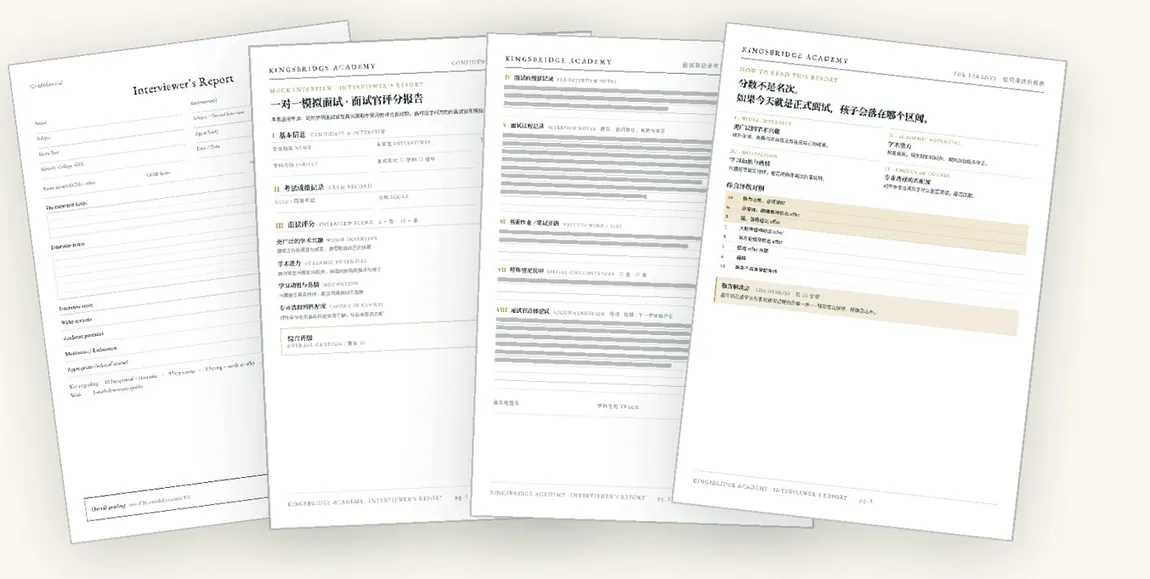
The form the colleges themselves use, filled in by the interviewer as the mock ends.
Four dimensions scored one by one, plus an overall grade.
How far the follow-ups went, what held up, what to train next.
How to read the score — what an 8 means, and where the answer sits today.
Every subject has a written interview syllabus: first what that subject’s interview actually tests, then week by week what to train. Below is the shape of each; the full document is provided by subject at the entry assessment.
Eleven modules
Algebra, calculus, graph sketching, sequences, number theory, geometry, combinatorics, proof, mechanics, further-maths extensions and unfamiliar definitions — each marked CORE / COMMON / EXTENSION / DEFINITION-LED, opening with how the two universities' interviews differ and what each observes.
Thirteen weeks, one or two skills each
Defining the question and time discipline → analytical precision and self-correction → conceptual breadth and comparative statics → application and data interpretation → flexibility and hypotheticals → multidimensional thinking → A-level to Cambridge translation and model building → two-track thinking and trade-offs. Each week pairs a maths drill with an economics discussion.
Eight formats, then nine weeks
It first names the eight things a PBS interview does — critiquing an unseen study, reading graphs and light statistics, biological psychology, perception think-alouds, research methods, definitions, ethics and policy, and the personal statement — then builds through eight weeks to a ninth week of two full mocks, scored against a rubric.
Fifteen weeks, fourteen mocks
From a diagnostic mock in late August to the final rehearsal two or three days before the interview: every week sets what technical work, what delivery work, and how many full mocks — and whether the interviewer or the undergraduate tutor runs it.
Eight seminars and an assessed mock
Introduction → question types → probing and multi-round pushing → personal statement → breaking down and modelling → past questions I and II → integration; then a one-to-one assessed mock and a written report. Physical and Biological tracks train separately.
Two markers, two halves
Section A is taught by the top Cambridge LNAT multiple-choice scorer — question taxonomy and twenty recurring wrong-answer types; Section B by an Oxford Law LNAT essay marker — the marking criteria, argument structure and handling counter-arguments. Interview training is led by Oxbridge Law admissions interviewers.
These are Kingsbridge's own preparation syllabuses, built from the universities' published admissions guidance, college interview pages and public specimen material. They are not official university syllabuses.
Physics · Chemistry · Engineering
For Cambridge NatSci (physical), Cambridge Engineering, Oxford Physics / Chemistry / Engineering Science
- Reading graphs and quantitative relationships
- Basic models and order-of-magnitude estimates
- Qualitative reasoning and limiting cases
- Intuition → model → check the result
- Knowing where the maths stops helping
Biology · Biochemistry
For Cambridge NatSci (biological), Oxford Biology / Biochemistry / Biomedical Sciences
- Observing phenomena and explaining mechanisms
- Variables and experimental design
- Mechanism → hypothesis → prediction
- Interpreting data and figures
- Layer after layer of “but why?”